Employment Lawyer Marketing: 9 Strategies to Win More Clients
Categories: Legal Marketing Strategies
 Abram Ninoyan
Founder & Senior Performance Marketer
Credentials: Google Partner, Google Ads Search Certified, Google Ads Display Certified, Google Ads Measurement Certified, Google Analytics (IQ) Certified, HubSpot Inbound Certified, HubSpot Social Media Marketing Certified, Conversion Optimization Certified
Expertise: Google Ads, Meta Ads, Conversion Rate Optimization, GA4 & Google Tag Manager, Lead Generation, Marketing Funnel Optimization, PPC Management
LinkedIn Profile
Most employment lawyer marketing plans fail for one reason: they generate calls, not signed cases. You run ads for wrongful termination or wage-and-hour claims, the phone rings, and then the lead goes...
Key Takeaways
- Employment Lawyer Marketing: 9 Strategies to Win More Clients
- 1. Track cost per signed case with a legal-specific platform
- 2. Build a website that converts employees and employers
- 3. Optimize local SEO and your Google Business Profile
Employment Lawyer Marketing: 9 Strategies to Win More Clients
Most employment lawyer marketing plans fail for one reason: they generate calls, not signed cases. You run ads for wrongful termination or wage-and-hour claims, the phone rings, and then the lead goes cold because nobody called back fast enough or the intake form scared off a mobile visitor. A widely cited Lead Response Management study found that firms responding within 5 minutes are 21 times more likely to qualify a lead than firms that wait 30 minutes, which means your marketing budget only works if your intake process keeps up.
This article gives you nine strategies built specifically for employment law, a practice area with long sales cycles, sensitive client situations, and heavy competition on terms like "unpaid overtime lawyer" and "discrimination attorney near me." You'll get tactics for Google Ads, local SEO, referral pipelines, and reputation management, plus the intake and follow-up systems that turn clicks into retainers.
We'll also cover cost-per-signed-case benchmarks so you know whether your numbers are competitive, and where speed-to-lead automation fits into a firm that's still growing its intake team. If you've been measuring success by call volume instead of signed cases, that's the first thing to fix.
1. Track cost per signed case with a legal-specific platform
Every employment lawyer marketing campaign produces a cost-per-lead number, but that figure tells you almost nothing about whether the campaign is profitable. A firm paying $85 per lead on wage-and-hour ads looks efficient until you learn that only 1 in 20 of those leads ever signs a retainer. Cost per signed case is the metric that actually predicts revenue, and you can't calculate it without signed case attribution that follows a lead from the first ad click all the way to a signed engagement letter.
If you're still optimizing for cost per lead instead of cost per signed case, you're optimizing for the wrong number.
How it works
A law firm marketing platform built for signed-case tracking tags every lead with its originating campaign, then carries that tag through the intake form, the pipeline, and into case management. When a case gets marked signed, the system attributes it back to the ad, keyword, or referral source that generated it. That's a meaningfully different view than what generic marketing tools give you, since most were built for e-commerce funnels, not multi-month legal intake.
The benchmark comparison matters more than most firms realize. GavelGrow's modelled benchmark lets you see whether your cost per signed case for employment law leads is running above or below cost per signed case benchmarks by practice area for firms with a similar practice mix and market size. Without that context, a $600 cost per signed case looks either great or terrible depending on nothing but your gut.
Who it's best for
This approach suits firms already spending real money on paid client acquisition (Google Ads, Local Services Ads, or paid social) who currently can't answer a simple question: which campaigns actually produce signed clients? It also fits firms juggling separate tools for call tracking, intake forms, and case status, since a unified platform replaces that patchwork with one dataset.
Cost and time investment
You can compare platform tiers from $199 to $599 per month, each with a 7-day free trial that requires no credit card. Setup typically takes a few hours: connecting your Google Ads account for the daily sync, embedding intake forms on your site, and porting over existing tracking numbers. Most firms see clean attribution data within the first billing cycle, which is fast enough to catch a losing campaign before it burns through another month of ad spend.
2. Build a website that converts employees and employers
Employment law firms often serve two very different visitors on the same domain: a worker who just got fired and an HR director looking for defense counsel. Employment lawyer marketing falls apart when your homepage speaks to only one of them, since a generic "contact us for a consultation" page doesn't answer the specific anxiety of either visitor. A site built for conversion separates these paths early, with distinct landing pages for plaintiff-side claims like wrongful termination and defense-side services like policy audits and compliance training.
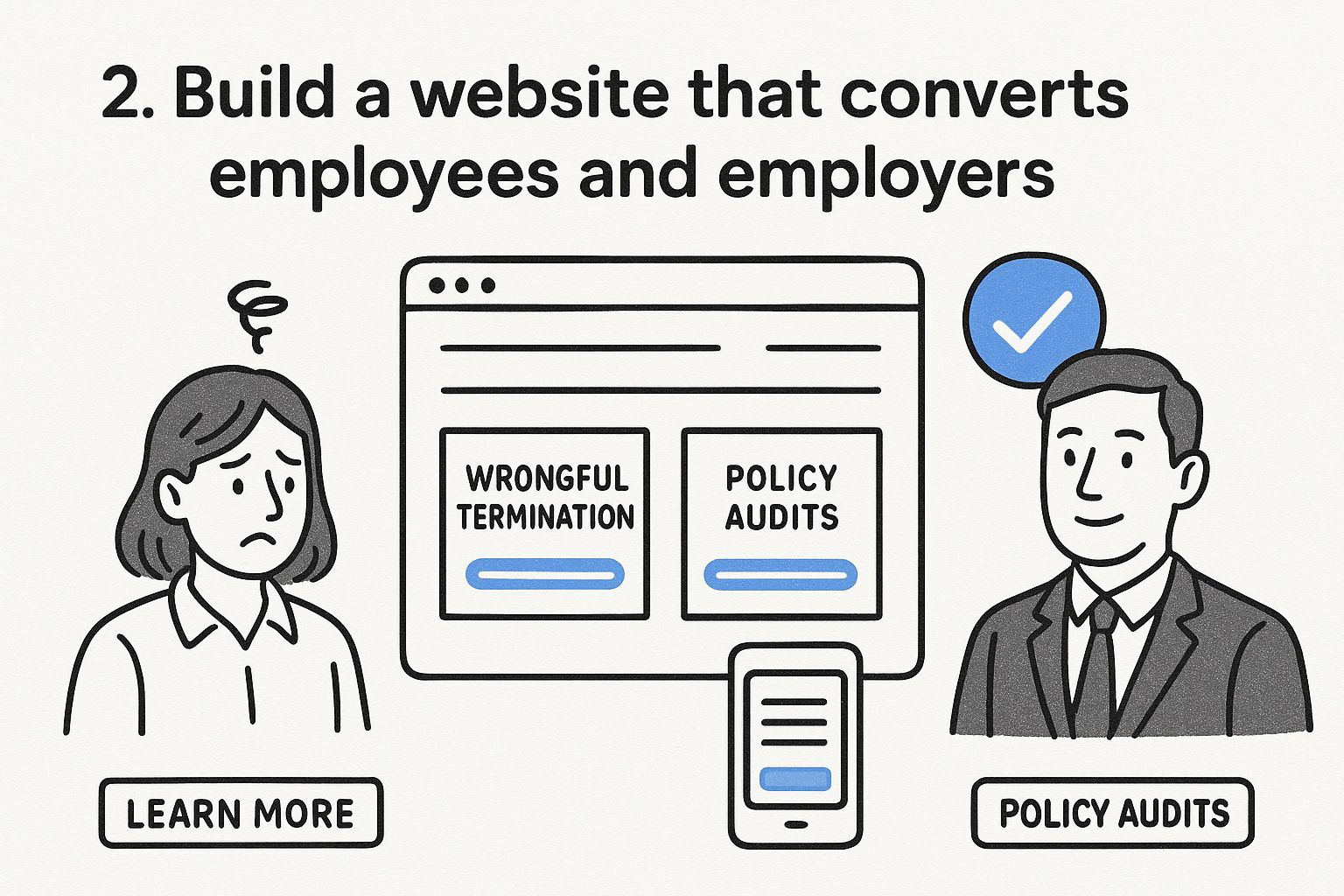
A website that tries to speak to everyone usually converts no one.
How it works
Getting this right means improving conversion rates on practice-area pages by building dedicated pages for your highest-value practice areas (wage-and-hour, discrimination, retaliation), each with a mobile-first intake form above the fold. GavelGrow's hosted and embeddable intake forms drop into any practice-area page in minutes and include carrier-level phone validation and instant auto-reply, so a visitor who submits at 11pm still gets a confirmation text before they close the tab.
Who it's best for
Firms handling both plaintiff and defense work benefit most, since the split-path structure prevents an HR manager from wading through content aimed at terminated employees. Solo practitioners focused only on plaintiff-side claims still need this, just with narrower page architecture.
Cost and time investment
A conversion-focused rebuild typically runs $8,000 to $25,000 with an agency, or less if you're restructuring an existing site rather than starting over. Expect four to eight weeks for design, copy, and form integration. If you're already running GavelGrow's platform, form deployment adds no separate cost since it's included at every pricing tier.
3. Optimize local SEO and your Google Business Profile
Most employment law searches start with a location attached: "employment lawyer Sacramento" or "wrongful termination attorney near me." If your Google Business Profile is thin or your site doesn't rank for these city-plus-practice-area terms, you're invisible at the exact moment someone decides to hire. Ranking in Google's map pack is one of the few employment lawyer marketing channels where a smaller firm can outrank a bigger one just by being more thorough.
A firm with a fully optimized Google Business Profile often beats a firm with a bigger ad budget on local search alone.
How it works
Start with the profile itself, which is exactly what Google Business Profile management includes: complete every field, upload real office photos, list every practice area separately (discrimination, wage-and-hour, retaliation), and post updates monthly so Google sees an active account. Then build location-specific landing pages on your site targeting each city or county you serve, since a single generic "service area" page rarely ranks. Reviews factor heavily into local rankings too, which is why review generation, covered later in this list, works hand-in-hand with SEO rather than as a separate task.
Who it's best for
This strategy fits solo and small firms serving one metro area especially well, since local search rewards proximity and specificity over brand size. Firms with multiple office locations benefit even more, provided each location gets its own optimized profile rather than one shared listing.
Cost and time investment
DIY optimization costs nothing but time, roughly 10 to 15 hours upfront and a few hours monthly for maintenance. Hiring a local SEO specialist runs $500 to $2,500 per month, with meaningful ranking movement typically taking three to six months. Compared to paid ads, local SEO is slower to show results but keeps producing leads long after you stop actively working on it.
4. Publish content that answers real workplace law questions
Employees searching "can my boss fire me for filing a workers comp claim" or "how much is my wrongful termination case worth" are often weeks away from calling a lawyer, not minutes. Content marketing built around these specific, anxious questions puts your firm in front of them early, before they've even typed "employment lawyer" into Google. This is the strategy most employment lawyer marketing plans skip because the payoff is slow, which is exactly why it's underused by competitors.
The firm that answers the question first usually gets the call later.
How it works
A legal content marketing strategy starts with a library of articles organized around real questions: severance negotiation, unpaid overtime calculations, retaliation timelines, non-compete enforceability by state. Each piece should end with a clear next step, not a vague "contact us," and link to the relevant practice-area page carrying an intake form. Video versions of the same content, covered next, extend reach to visitors who'd rather watch than read. Update older posts when laws change; a 2022 overtime threshold article that never mentions the current federal minimum salary loses credibility fast.
Who it's best for
Firms competing in crowded metro markets benefit most, since content lets you rank for hundreds of long-tail questions competitors never bother targeting. It also suits firms building a referral reputation among HR consultants and other attorneys, since well-researched content gets shared and cited within professional networks.
Cost and time investment
An in-house attorney writing one detailed post a month costs only time, roughly four to six hours per piece including research. Hiring a legal content writer runs $300 to $800 per article, and an agency-managed program with SEO strategy typically costs $2,000 to $5,000 per month. Expect six to twelve months before content meaningfully contributes to signed cases, since search rankings build gradually rather than overnight.
5. Run Google Ads and Local Services Ads for urgent searches
Someone searching "fired for reporting harassment what to do" tonight wants a lawyer this week, not after six months of SEO content builds momentum. Google Ads and Local Services Ads put you in front of that person immediately, which makes paid search the fastest lever in any employment lawyer marketing plan when a firm needs signed cases now rather than eventually.
Paid search buys you speed; everything else on this list buys you compounding.
How it works
Google Ads campaigns target high-intent keywords like "unpaid overtime lawyer" or "wrongful termination attorney," with ad copy and landing pages matched tightly to the search term, which is where Google Ads setup, costs, and lead quality all come together. How Local Services Ads rank and bill works differently: Google vets your bar license and insurance, then charges per lead instead of per click, which shifts risk away from clicks that never convert. Both channels need daily bid and budget monitoring, since employment law keywords often cost $40 to $150 per click in competitive metros.
Who it's best for
Firms with cash flow to sustain a testing period fit this best, since the first 60 to 90 days usually go toward finding profitable keywords rather than producing cheap cases. It also suits firms that already track cost per signed case, because without that number you can't tell a winning campaign from one quietly draining your budget.
Cost and time investment
Budget varies widely: solo practices often start at $2,000 to $5,000 monthly in ad spend, while firms chasing mass-tort-adjacent employment claims spend $15,000 or more. Managing campaigns in-house takes 5 to 10 hours weekly; done-for-you campaign management covers bidding, copy, and optimization for firms that would rather outsource the whole channel.
6. Cut response time with intake automation and call tracking
Every strategy above exists to generate a lead, and every lead you generate is worthless if nobody reaches it fast. A widely cited Lead Response Management study found that firms responding within 5 minutes are 21 times more likely to qualify a lead than firms that wait 30 minutes, which means response time is arguably a bigger lever than any single ad campaign on this list. Employment lawyer marketing budgets get wasted every day by firms with great ads and a slow front desk, which is why most law firm leads never get a callback at all.
Speed to lead beats almost every other variable in your control.
How it works
Intake automation workflows fire an SMS and email within seconds of a form submission or missed call, confirming receipt before a prospective client even considers calling the next firm on their search results page. GavelGrow's intake automation sends these sequences within 60 seconds and handles CTIA opt-out keywords automatically, so compliance doesn't slow the response down. Pair that with call tracking software options for law firms, which assign a unique number per campaign, record calls, and tag outcomes as qualified, callback, unqualified, or spam, giving you a miss-rate breakdown per number so you know exactly which campaigns are losing calls to voicemail.
Who it's best for
Solo and small firms without a dedicated intake staffer benefit most, since automation covers gaps nights and weekends create. Growing firms replacing CallRail and a separate texting tool also fit here, since consolidating call tracking and SMS into one system removes the reconciliation work of matching data across platforms.
Cost and time investment
Call tracking and intake automation come included in every GavelGrow platform tier, starting at $199 monthly, with per-number and per-SMS overage billing at higher volumes. Setup takes an afternoon: porting existing tracking numbers and writing your auto-reply templates. Most firms see measurable drops in missed calls within the first two weeks.
7. Use video and social media to build early trust
Workers rarely hire the first employment lawyer they find. They watch a few videos, scroll a firm's Instagram, and decide who sounds like they'll actually listen before they ever fill out a contact form. Video content shortens that trust-building phase because it lets a prospective client hear your tone and see your face before the consultation, which matters enormously in a practice area built on sensitive, often humiliating workplace situations.

People hire the lawyer they feel like they already know, not the one with the best ad copy.
How it works
In video marketing for attorneys, short videos answering common questions ("what counts as retaliation," "do I have a case if I signed a severance agreement") work better than polished firm-overview reels, since searchers want answers, not a sales pitch. Post the same clips to YouTube, LinkedIn, and Instagram, and repurpose the transcripts into the blog content covered earlier in this list. Social proof compounds here too; a short client testimonial video, recorded with permission and reviewed for bar compliance, does more for conversion than a page of written reviews.
Who it's best for
Attorneys comfortable on camera see the fastest returns, since authenticity reads clearly on video in a way it doesn't in text. Firms building a referral network among HR consultants and union reps also benefit, because shareable video content travels through professional circles faster than a static webpage ever will.
Cost and time investment
A smartphone, a $50 lav mic, and an hour of recording time can produce a month of short clips. Hiring a videographer for a quarterly shoot runs $1,500 to $4,000. Editing and posting takes two to four hours weekly if handled in-house, or fits into GavelGrow's content marketing support for firms outsourcing the whole channel.
8. Nurture leads with email and marketing automation
Most employment law leads don't sign the day they inquire. Someone weighing a wrongful termination claim often waits weeks while they finish a severance negotiation, gather documents, or just work up the nerve to sue a former employer. Lead nurturing through email and SMS keeps your firm top of mind during that gap instead of losing the prospect to whichever competitor happens to follow up again first.
The lead you nurture for six weeks often signs faster than the one you called once and forgot.
How it works
Nurture sequences that convert inquiries into retainers send automatically after intake, mixing case-relevant education (what to expect in a deposition, how severance agreements affect a claim) with gentle reminders to schedule a consultation. GavelGrow's intake automation triggers these sequences the moment a lead enters the pipeline and logs every SMS, email, and voicemail in one unified inbox, so an attorney picking up the file later sees the full conversation history instead of piecing it together across four tools. Marketing automation like this also flags leads that go cold, prompting a manual check-in before they disappear entirely.
Who it's best for
Firms handling long-cycle claims like discrimination or wage-and-hour class actions benefit most, since these cases routinely take months to move from lead to signed retainer. It also suits firms with a small staff, since automation handles the repetitive follow-up that a solo intake coordinator can't sustain across dozens of open leads.
Cost and time investment
Email and SMS nurture sequences are included in GavelGrow's platform starting at $199 monthly, with usage-based SMS overage at higher volumes. Building the initial sequence takes three to five hours of writing and setup. Standalone marketing automation tools built for other industries often run $300 to $1,000 monthly and require far more manual configuration to fit legal intake rules.
9. Manage reviews and reputation the ethical way
A five-star Google rating often decides whether a worker calls you or the firm listed above you. Employment law brings extra sensitivity here, since a client who won a harassment or discrimination case may not want their name attached to a public review, and state bar rules restrict how you can solicit or respond to feedback. Reputation management for employment lawyer marketing means building a steady flow of honest reviews without pressuring clients or violating advertising rules.
A rushed five-star request can cost you more in bar complaints than it earns you in rankings.
How it works
Managing your firm's online reviews starts with asking at the right moment, right after a favorable settlement or case resolution, using a simple text or email link rather than an in-person ask that can feel coercive. Never offer anything in exchange for a review, and train staff to escalate an unhappy client to a partner for direct resolution, while still asking every client for a review. GavelGrow's reputation management support builds this into the referral and retention side of managed services, timing requests around case milestones already tracked in your case management pipeline.
Who it's best for
Firms with a steady volume of resolved cases benefit most, since consistent case flow means a consistent review pipeline instead of sporadic requests. Solo practitioners just starting out should still request reviews from every satisfied client, since even ten strong reviews can outrank a competitor sitting on three-year-old feedback.
Cost and time investment
Manual review requests cost nothing but a few minutes per closed case, roughly 20 to 30 minutes weekly for a small practice. Software-assisted review campaigns run $50 to $300 monthly through standalone tools, while GavelGrow bundles review timing into its managed services packages, which are scoped on a strategy call. Expect a visible rating improvement within two to three months of consistent requests.
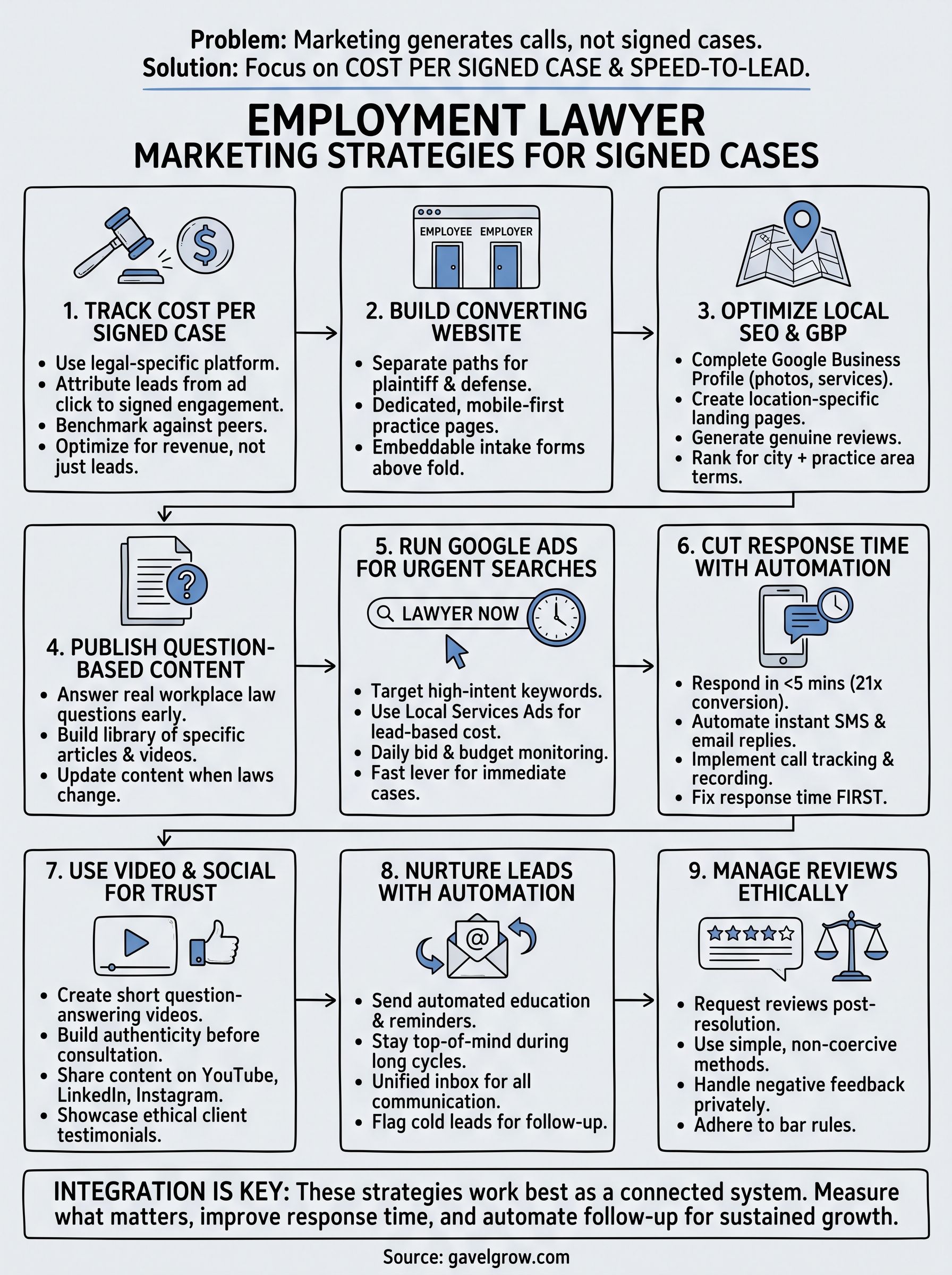
Turning these strategies into signed cases
None of these nine strategies work in isolation. A perfectly optimized Google Business Profile still loses cases to a slow callback, and a brilliant Google Ads campaign still bleeds budget without cost-per-signed-case tracking behind it. Employment lawyer marketing succeeds when acquisition, intake, and follow-up run as one connected system instead of nine separate projects competing for attention.
Start small if you have to. Fix response time first, since that single change touches every other strategy on this list. Then layer in tracking, so you actually know which channels deserve more budget and which ones need to be cut. The firms sitting at the top of local search results and closing the most workplace law cases aren't necessarily spending the most, they're just measuring what matters and acting on it fast.
If you want to see where your own intake and attribution gaps are costing you signed cases, schedule a free 45-minute employment law marketing strategy call and we'll walk through it together.
Frequently Asked Questions
How do employment lawyers get more clients?
Most employment law clients arrive in a moment of crisis, right after a termination, a denied wage claim, or a harassment incident, and they search before they call. That makes local visibility and response speed the two biggest levers: rank where people search for wrongful termination or wage-and-hour help in your area, then respond within minutes. Content that answers real workplace questions builds the trust that converts a researcher into a consultation.
Is marketing different for plaintiff-side versus employer-side employment law?
Substantially. Plaintiff-side work is consumer marketing: individual employees searching in distress, reachable through local search, ads, and educational content, and won on speed and empathy. Employer-side work is B2B: businesses and HR leaders who hire through referrals, professional networks, and reputation, with a longer, relationship-driven cycle. Firms doing both usually need separate messaging and separate landing pages, since a single page cannot speak to a fired employee and the company that fired them.
What keywords matter most for employment lawyer marketing?
The highest-intent terms pair a specific claim with a location, like wrongful termination lawyer or wage and hour attorney plus your city. Beyond those, employees research long-tail questions first, such as whether a firing was legal, how overtime is calculated in their state, or what counts as retaliation. Pull the phrasing from your own intake calls, since the words prospects actually use convert better than the ones a keyword tool suggests.
How much should an employment law firm spend on marketing?
There is no universal figure, and employment law click costs sit below personal injury but well above most practice areas. What matters more than the total is the mix and the measurement: a smaller budget tracked to cost per signed case usually outperforms a larger one spread across channels you cannot attribute. Start with the channels closest to hiring intent, prove the return, then expand.
How do bar advertising rules apply to employment law marketing?
The same rules that govern all attorney advertising apply here: no guaranteeing outcomes, no implying a specific settlement value, and disclaimers on results-based claims in most states. Client testimonials require consent and usually a disclaimer, and review solicitation cannot be incentivized. Check your state bar’s advertising rules before running any campaign and keep records of what you ran and the consent behind every lead you contact.
How long does employment law marketing take to produce cases?
It depends on the channel. Paid search and Local Services Ads can generate calls within days, though it takes a few weeks to tune bidding and intake. Local SEO, reviews, and content compound more slowly, typically four to six months before rankings move meaningfully. Most firms run the fast paid channels while the slower organic ones build underneath, and judge both on cost per signed case rather than lead volume.
Frequently Asked Questions
How do employment lawyers get more clients?
Most employment law clients arrive in a moment of crisis, right after a termination, a denied wage claim, or a harassment incident, and they search before they call. That makes local visibility and response speed the two biggest levers: rank where people search for wrongful termination or wage-and-hour help in your area, then respond within minutes. Content that answers real workplace questions builds the trust that converts a researcher into a consultation.
Is marketing different for plaintiff-side versus employer-side employment law?
Substantially. Plaintiff-side work is consumer marketing: individual employees searching in distress, reachable through local search, ads, and educational content, and won on speed and empathy. Employer-side work is B2B: businesses and HR leaders who hire through referrals, professional networks, and reputation, with a longer, relationship-driven cycle. Firms doing both usually need separate messaging and separate landing pages, since a single page cannot speak to a fired employee and the company that fired them.
What keywords matter most for employment lawyer marketing?
The highest-intent terms pair a specific claim with a location, like wrongful termination lawyer or wage and hour attorney plus your city. Beyond those, employees research long-tail questions first, such as whether a firing was legal, how overtime is calculated in their state, or what counts as retaliation. Pull the phrasing from your own intake calls, since the words prospects actually use convert better than the ones a keyword tool suggests.
How much should an employment law firm spend on marketing?
There is no universal figure, and employment law click costs sit below personal injury but well above most practice areas. What matters more than the total is the mix and the measurement: a smaller budget tracked to cost per signed case usually outperforms a larger one spread across channels you cannot attribute. Start with the channels closest to hiring intent, prove the return, then expand.
How do bar advertising rules apply to employment law marketing?
The same rules that govern all attorney advertising apply here: no guaranteeing outcomes, no implying a specific settlement value, and disclaimers on results-based claims in most states. Client testimonials require consent and usually a disclaimer, and review solicitation cannot be incentivized. Check your state bar’s advertising rules before running any campaign and keep records of what you ran and the consent behind every lead you contact.
How long does employment law marketing take to produce cases?
It depends on the channel. Paid search and Local Services Ads can generate calls within days, though it takes a few weeks to tune bidding and intake. Local SEO, reviews, and content compound more slowly, typically four to six months before rankings move meaningfully. Most firms run the fast paid channels while the slower organic ones build underneath, and judge both on cost per signed case rather than lead volume.